Scenarios
The report shows how people relate to a certain norm or reference group. Then it is important to see whether the person recognizes himself in the picture that is painted in the report. Does his or her self-image match the image from the report? The combinations of the level of the scores and the degree of recognition can result in different scenarios. It is most interesting when someone does not recognize themselves in the results. It is important that attention is paid to this during the conversation to find out a possible cause of this. The different scenarios are shown in the diagram below (in Dutch):
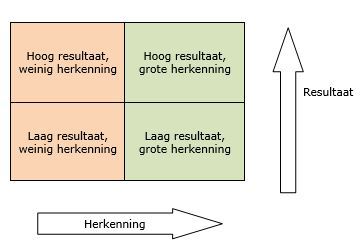
An example of a STARR is worked out below for each scenario.
Scenario 1: Low result and little recognition
It may be that people do not recognize themselves in a below-average to (very) low result. In such a situation, there is a risk that a discussion will arise about the test and the questions from the test, as a result of which it is no longer about the interpretation of the results. For recognition and interpretation, it is important to ask for examples of behaviour in which competence came to the fore. These can be requested using a STARR (see examples below).
There can be several reasons why people do not recognize themselves in the results:
- The questions were not properly understood and therefore filled in differently than the intention of the questionnaire.
- The person rates himself higher.
- The student wanted to fill in the test in a certain way, for example by not wanting to score above average and filling in everything in the middle.
- The person does not agree with the test goal; There is resistance.
Possible questions:
- "How did you complete the test?"
- "Can you give an example of a situation in which you had to show competence?"
- "I have the feeling that the conversation is not going smoothly. How do you experience this?"
Example of a conversation:
Man, 19 years old, has enrolled in the Accountancy course.
Teacher: "Welcome, (intro etc..). What do you think of the results of the report?"
Student: "The result in the competency of oral communication is not correct."
D: "Oh, that's annoying. How would you assess yourself on this competency?"
S: "Good."
D: "Can you give an example of the last time you had to communicate something verbally?"
S: "Ehmm, I don't know."
D: "And during high school? Did you ever have to present something then?"
S: "Not really.."
D: "(Silence)..... Nothing at all?"
S: "No."
D: "I have the feeling that the conversation is not going smoothly. How do you experience this?"
S: "Not really, no."
D: "What do you think is the reason for this?"
S: "I think this whole intake story is nonsense. I have my HAVO diploma, isn't that enough to be admitted?"
D: "So if I understand correctly, you don't see the point of the intake assessment?"
S: "That's right."
D: "We would like to get to know you. Furthermore, we cannot reject you on the basis of this conversation. But we can support you when needed. Oral communication is important during the training. By getting an idea of how good you are at this before the start of the training, extra attention can be paid to it from the start of your training so that you do not fall behind."
S: "Oow, that's pretty positive."
Scenario 2: Low result and high recognition
It may be that people recognize themselves in a below-average to (very) low result. They may have a good idea of what their less developed competencies are. If a below-average result is achieved on many competencies, it may be that something else is going on. For example, someone may have low self-esteem. It is also possible that someone has little experience with the required competencies.
Example of a conversation:
Man, 18 years old, has enrolled in the Journalism course.
Teacher: "Welcome, (introduction). What do you think of the results of the report?"
Student: "Yes, I was already a bit afraid of it."
D: "What do you mean?"
S: "Well, I didn't really have much confidence in it when I took the test."
D: "Let's take a look at your report. I do see that you score below average on a few competencies, but on a number of competencies you are just around average."
S: "yes, hmm."
D: "If you look at all these competencies, what would you characterize as a strong point of yourself? Regardless of where the ball is now."
S: "I don't really know"
D: "No way?"
S: "Yes, I think I would write, although that doesn't really come out well in the report either. Indeed, I don't know if that's really good enough."
D: "What is your experience with writing?"
S: "I wrote some pieces for the school newspaper in high school."
D: "Nice, about what?"
S: "Well, it didn't go very well."
D: "Hm, what exactly was it that you wrote about?"
S: "We went on a study trip to Paris and I wrote a short report about it."
D: "Aha, did you have to do this alone or with other people?"
S: "I wrote the report, someone else took care of the layout and photos and everything was still looked at by the editor-in-chief."
D: "You said earlier that you didn't think it went very well. What exactly was the reason for that?"
S: "Well, I had the feeling that it could all be a bit better."
D: "What did the others think?"
S: "Yes, they liked the writing, but I had the idea that it could be a lot more original."
D: "Do you often have that feeling?"
S: "Yes, I'm often quite critical."
D: "Aha, that may explain the results in the report. But you indicate that others were satisfied with your work. Do you remain dissatisfied yourself?"
S: "For me, it's mainly about whether I'm satisfied myself."
D: "What about your school grades, for example........"
Etcetera.
Scenario 3: High result, little recognition
It may be that the results on a competency are higher than expected. In that case, when filling in the form, people may have mainly thought of positive situations or thought of how they would like to master a certain competence. When filling in the form, one may also have focused on what the expectations are that one thinks one will have to meet.
Example of a conversation:
Woman, 19 years old, has enrolled in the Business Administration MER course
Teacher: "Welcome, (intro etc..). What do you think of the results of the report?"
Student: "Nice, nice and positive."
D: "You sound a bit surprised."
S: "Yes, in general it is similar. Only on a few points I had estimated myself less highly."
D: "Aha, on what competency, for example?"
S: "Well, on perseverance, for example."
D: "You don't see it that way?"
S: "Often yes, but I remember the other day, for example, when I went running in the rain. Then I only ran two laps.
D: "Sounds pretty good that you did run in the rain, but can you also give an example that you had to persevere in a study situation?"
S: "Eehm, yes for Frans for example, that really didn't suit me."
D: "Can you give one specific example?"
S: "Well, I wanted to finish Frans with a seven. For my last rehearsal, I didn't have to get lower than eight and a half. After that, fortunately, I was able to drop it, so that was nice. I also liked all the subjects. I found economics really interesting, so I could spend more time on that."
D: "Ok, back to that rehearsal, how did you go about getting those eight and a half?"
S: "Well, I divided everything up. Then I made a schedule so that I did something every day and could repeat it again. Sometimes I couldn't meet up with friends as much because of this. Normally we went shopping about every weekend and..."
D: "Aha, and that planning? How did that work in practice? ”
S: "Yes, sometimes it was a bit more difficult to combine as many things as possible, but in the end it was worth it."
D: "What was the result? Did you make it?"
S: "Yes, I ended up getting a nine."
D: "Neat! How do you look back on it afterwards?
S: "Yes, ok. I think I could have done a little better. If I had repeated it a few more times, it might have gone a little better. I was quite nervous now. I also didn't remember a few words."
D: "You did achieve your goal."
S: "Yes, it is"
D: I think you're quite critical of yourself. Maybe you haven't done enough according to your standard. When filling in the questions about this competency, you may have mainly thought about how you would like to master this competency. As a result, the result may have turned out to be higher than you had thought. During the test, you will be compared to other students. Compared to other students, you score well above average. From this you could deduce that you set the bar high for yourself. When I hear your story, you think you don't meet those high standards of yours."
S: Oh, that's how the report works.
Scenario 4: High result, great recognition
It will often be the case that people recognize themselves in the results. While answering the questions, people also assess and compare themselves with others. The only difference is that questions are now bundled in a scale and one is compared with a norm or reference group. Even if a person has an above-average score, it can be good to ask about this. This gives the conversation a positive tone and ensures that trust is created for the rest of the conversation. It is also possible that during the STARR that focuses on a certain competence, you will receive information about other competences that were used in the same situation. This can also be interesting.
Example:
Woman, 21 years old, has enrolled in the training to become a Physical Education Teacher.
Teacher: "Welcome, (intro etc..). What do you think of the results of the report?"
Student: "Yes, that's about right. I recognized myself in it."
D: "That's good to hear! I see that you score very high on the competency of collaboration. Do you have good experiences with this?"
S: "Yes, for example, I had to organize a closing party for the student council at my high school."
D: "Ow, how nice! What kind of party was that exactly? Was there a theme or were there special activities?"
S: "It was a gala. So a lot had to be arranged, a red carpet, photographer, decoration, you name it."
D: "That's a lot. What exactly was your role in that?" (Further STARR questions.........)
D: "Have there also been situations where the cooperation went less well?"
S: "Yes, that was for my profile paper."
D: "What was that profile paper about?"
S: "About Russia's influence on their neighbors from the cold war to the present day."
D: "Interesting. You had to do that profile paper together?"
S: "Yes with a fellow student, but that didn't work out at all."
D: "What was your role in the collaboration?"
S: "I had to go through literature and summarize it."
D: "And your fellow student?"
S: "He was responsible for the merging, layout and planning."
D: (Further STARR questions.........)
D: "And what is the difference between the first situation and the second situation?"
S: "Well, I found it very annoying that I was so dependent on my fellow student. She was often late with handing in pieces so I couldn't get along. I think keeping a schedule is important for my studies."
D: "How could you do this differently in the future?"
S: "Make good agreements in advance and address them earlier if she doesn't stick to them. Now I often waited, so I had to deal with time pressure myself."

