Test News - October 2026
1. New standards for MCT-M and MCT-H
In order to continue to assess candidates reliably, NOA has been working in recent months to create new standards for the MCT-M and MCT-H. Although the standards still met the COTAN criteria, renewal was desirable: the old standards of the MCT-M date from 2012 and those of the MCT-H from 2016. With the new standards, the reports are once again more in line with the current user population. See also this article in this newsletter.
The new standards will be available in NOA Talent Portal from 1 November 2026.
Users of the MCT-M and MCT-H will receive an email in October with more detailed information about the new standards. In addition, we will organize a webinar in November in which we will explain the new standards and discuss what they mean for the interpretation of test results.
2. T-scores in expert reports MCT-M/H
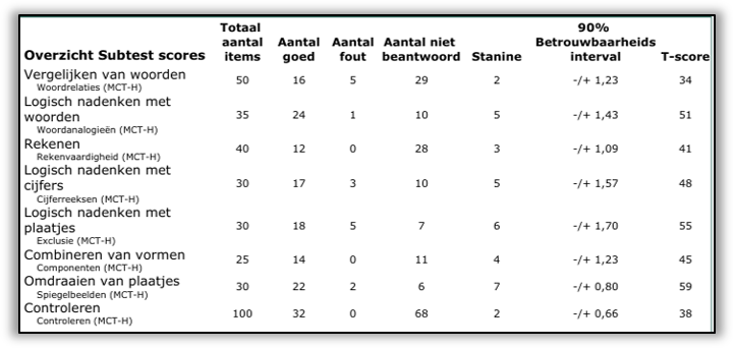
To make test results even more transparent, expert reports can now contain T-scores in addition to stanin scores. Both standards indicate how a candidate scores compared to a norm group. T-scores provide more detail, while stanines allow for quick and easy interpretation.
What are T-scores?
A T-score is a standardized score that allows test results to be easily compared with a norm group. On the T-score scale, the mean is 50 and the standard deviation is 10. T-scores are usually between 20 and 80 and can take all the intermediate whole values in whole numbers.
What is the difference between T-scores and Stanines?
T-scores and stanine scores show how someone scores compared to a norm group. T-scores represent an accurate position (mean = 50), while stanines summarize this position into nine categories (mean = 5). One difference is that stanin scores are normally distributed, with the scores being classified according to a symmetrical bell shape. This means that stanine five contains 20% of the candidates and that the other stanines around five contain the same percentage of candidates (stanine 4 and 6: 17%, 3 and 7: 12%, 2 and 8: 7% and 1 and 9: 4%).
NOA advises to use the stanine scores as a standard and to only use the T-score if one wants to differentiate within a stanine. Example of the addition to the new expert report:
3. New Picture Interest Test
How do you discover which career direction suits someone if language is a barrier? With the new Picture Interest Test (PIT), candidates can explore their interests in an accessible and visual way. The PIT was developed as a successor to the AWIT-R. The photos of the AWIT-R were no longer up to date and we noticed that there is a need for an expansion of the number of professional sectors. Twelve professional sectors are used in the new test.
Candidates choose from images that have been generated with AI and carefully modified. Extra attention has been paid to recognizability, diversity and a contemporary look.


The test is especially suitable for candidates for whom language may be a barrier in traditional professional interest tests. Think, for example, of students in special education or practical education, or of refugees or migrants who have only been in the Netherlands for a short time. The PIT can be taken in twelve different languages.
The PIT maps interests within the following professional sectors:
- Construction and infrastructure
- Administration
- Green
- Trade
- Hospitality and food
- Information and communication technology
- Logistics and transport
- Media and design
- Technique
- Grooming
- Safety
- Care and welfare
More detailed information will be available soon. Would you like to use the PIT now or know more about the possibilities? Please contact NOA via support@noa-vu.nl.
4. New career assessment helps job seekers move forward in a targeted way
Which education, position or field of work suits someone best? With the new Career Assessment – Job Search, job seekers get quick and practical insight into their talents, interests, preferences for a work culture and career drivers. The assessment is available in two variants: one for MBO level and one for HBO/WO level.
The assessment maps out various aspects that are important in choosing a suitable direction:
- Questionnaire on education and work experience
- Personality test (MPT-BS-(B)-Work)
- Interest test (practical/MBO level: DIT-M; theoretical/HBO/WO level: BKT-H)
- Work Culture Questionnaire
- Questionnaire about career drivers
This creates a broad and practical picture of what someone can, wants and finds important in work. This makes the assessment suitable for medium- and higher-educated job seekers who want to orient themselves on their talents and possible, possibly alternative, training and professions. The reports provide concrete tools for next steps, such as appropriate training, promising professions and current vacancies.
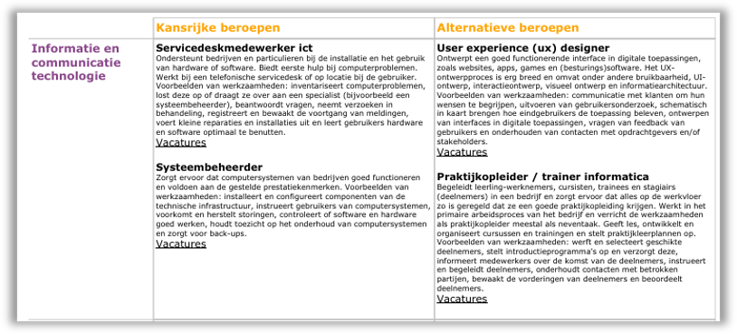
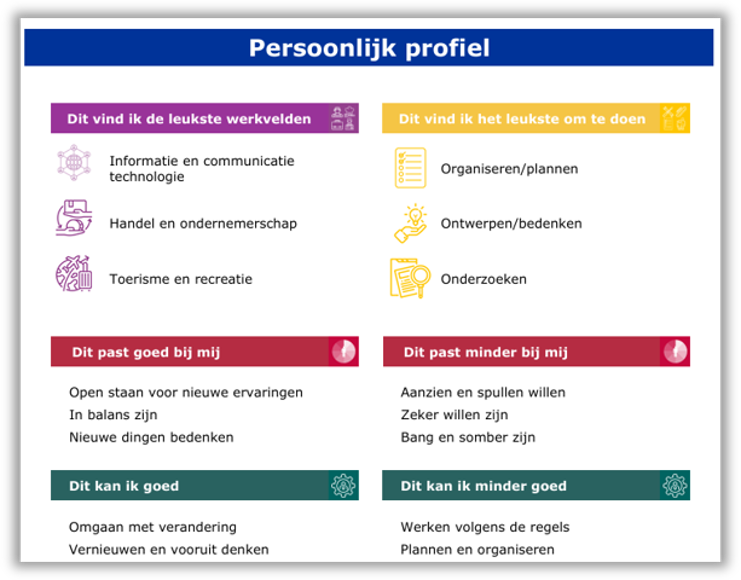
Curious about what such a report looks like? Click here for a complete sample report at the medium level. Would you like to know more about the possibilities or use the assessment for your candidates? Please feel free to contact us.
5. DIT-M now available in twelve languages
Good news for organisations that work with candidates from different language backgrounds: the Domains Interest Test (DIT-M) is now available in even more languages. As a result, the test can be used more widely for international students, refugees, status holders and candidates in reintegration processes, among others. With the multilingual DIT-M, candidates who do not yet have a good command of the Dutch language still get an accessible opportunity to explore their interests and choose a suitable education or professional direction.
From November 1, the test will be available in the following languages: • Dutch • English • German • French • Spanish • Turkish • Arabic • Tigrinya • Farsi/Persian • Chinese • Ukrainian • Russian
Do you want to help your candidates discover in their own language which direction suits them? Easily use the DIT-M via NOA Talent Portal or contact us for more information.

