From measuring agility to the road to work
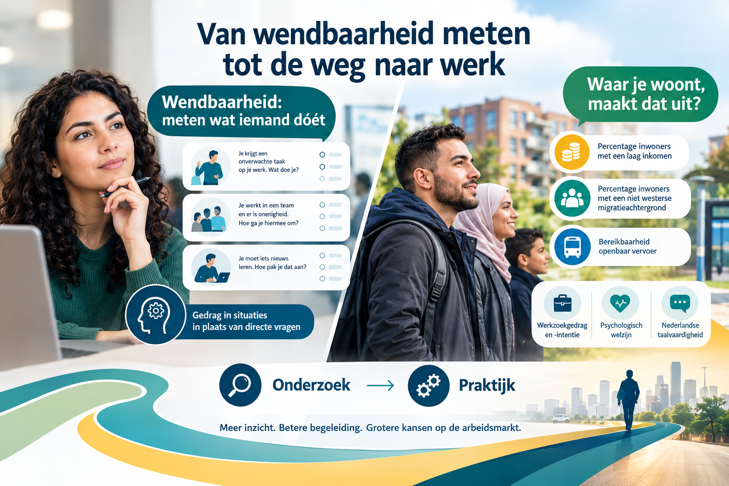
Can you measure agility without directly asking someone how agile they are? And does it matter where a status holder lives for his or her chances on the labor market? Two studies within NOA that Nathan Kaye is looking for answers to in his PhD research. Studies that are not only interesting from a scientific point of view, but can ultimately also have practical significance for assessments, guidance and the labor market.
Agility: measuring what someone does
The job market is constantly changing. Jobs change, organizations change, and employees are increasingly expected to be able to adapt. Agility is therefore an interesting property to measure.
But how do you do that reliably? Nathan is working on a new way to map agility. Instead of directly asking "How agile are you?", participants are presented with short situations or stories. Based on their reaction to these situations, an attempt is made to say something about their degree of agility. That may sound simple, but there is an important idea behind this approach. With traditional assessments, people can – sometimes unconsciously – give socially desirable answers. This can play a role especially with people who, due to their cultural background, are used to answering questions in a certain way. By not asking directly about a trait, but by investigating behaviour in different situations, it is examined whether you can reliably measure agility in a more indirect way.
From 94 items to the best questions
The investigation has now gone through two rounds. In the first round, 94 different situations and items were presented to a group of about 300 participants. Subsequently, it was investigated which items best distinguished between different levels of agility. An interesting result emerged. Situations in which there was very clear agile behaviour did not automatically work best. Nathan: "That actually makes sense: if almost everyone immediately recognizes a certain behavior as 'agile', it becomes difficult to distinguish people from each other based on their answers." The next step is therefore to investigate which situations do provide good insight into individual differences in agility.
From research to the workplace
The interest in this way of measuring does not come out of nowhere. Previously, NOA had already conducted research into a similar way of measuring integrity. However, agility is a different kind of construct: it's not just about personality, but also about attitude and behavior. That is precisely why agility is interesting for the labor market. It is a more applied concept that can provide concrete tools for the question of what someone needs in a work environment. Whether the new method of measurement actually works has not yet been definitively determined. A new round of research is currently underway for this. It investigates the extent to which the test can predict actual performance at work. The results are not yet known. If it turns out that the test can indeed predict work performance, it is an important step towards an assessment that can have value in practice.
Where you live, does that matter?
The second study looks at a completely different topic: the integration of status holders in the Netherlands. The central question is what influence the living environment has on various aspects of their integration. An important nuance: the research does not look directly at the question of whether someone has actually found work. The available data do not provide a direct answer to this. However, job search intention and job search behavior, psychological well-being and Dutch language skills are examined. Job search behaviour concerns, for example, the question to what extent someone is actively looking for work and what intention someone has to find work. Psychological well-being focuses on negative symptoms such as anxiety, depression and fatigue. The command of the Dutch language also plays a role in the extent to which someone can participate in the workplace and manage in Dutch society.
First results
The research has shown that the living environment certainly has an influence on the three points mentioned above and thus on finding work. Three factors that play a role in this are: the percentage of residents with a low income, the percentage of residents with a non-Western migration background and the accessibility of public transport. These results also have a political value. Especially in light of the resistance to the dispersion law. Because ultimately, the dispersion law determines where status holders receive housing. And this does not happen on the basis of the best outcome for the status holder, where he/she has the best chance of integration and a future. Which is also the best outcome for society.
A special source of data
The study uses a large dataset with data from about 4,500 Syrian status holders, collected between 2016 and 2025. The data was originally collected for guidance and orientation on the Dutch labour market, the education system and daily life in the Netherlands, among other things. Not as research data, in other words. But precisely because so much information has been collected, the dataset now offers the opportunity to answer new research questions. Nathan: "The choice to look specifically at Syrian status holders is deliberate. They form a large group within the refugee population in the Netherlands. At the same time, it is important to be careful about generalizing the results." Refugees are not a homogeneous group. Differences in background, culture and personal circumstances can cause patterns to be different for one group than for another.
From research to practice
Although the two studies differ greatly in terms of content, they have one important similarity: they look for knowledge that can ultimately be used in practice. A reliable way to measure agility can help to better understand what someone needs in the workplace. And research into the influence of the living environment on job-seeking behaviour, well-being and language skills can provide new insights for the guidance of status holders.
In this way, scientific research directly touches on daily practice.
Because the better we understand what helps or hinders people, the better we can support them on their way to work.

